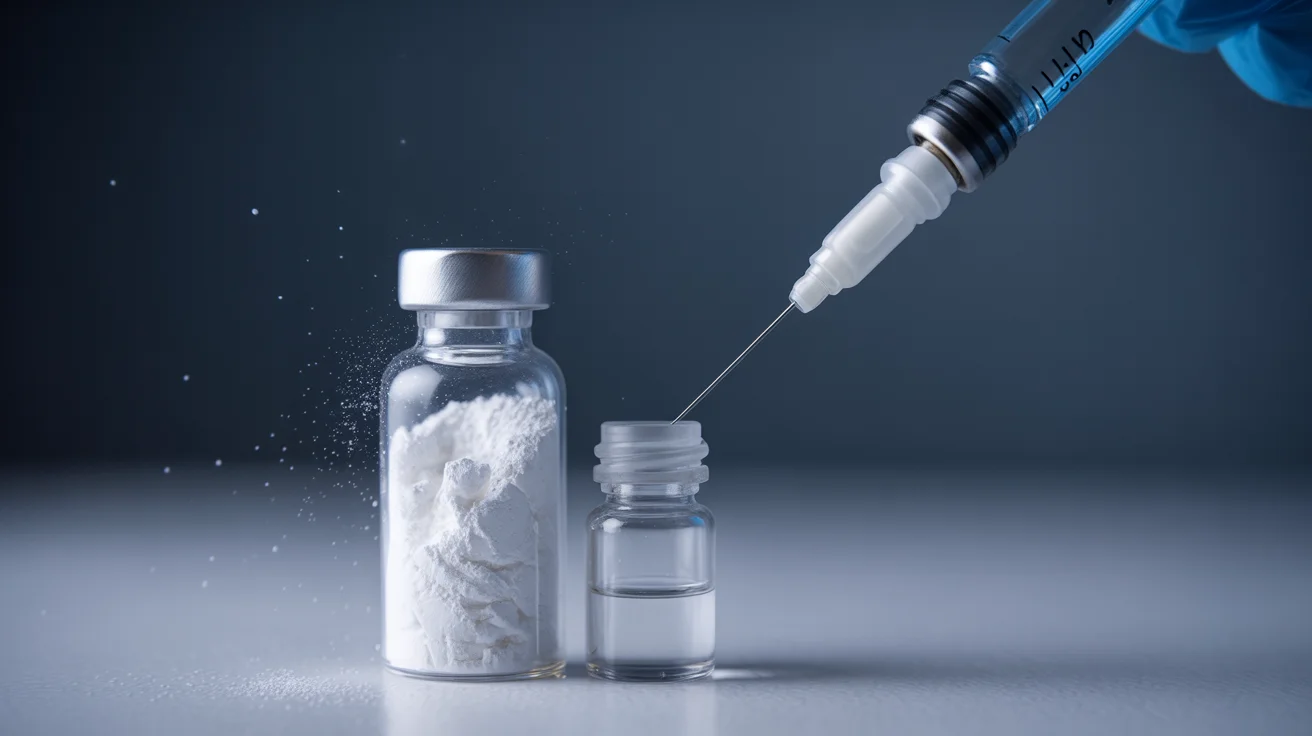
"Same syringe" is one of the most common questions in peptide research forums, and one of the most carelessly answered. The honest answer is that compatibility is a chemistry question with five inputs, not a yes/no lookup. This reference walks through each input, applies it to the active research-peptide catalog, and groups every common compound into one of four tiers: pre-validated blends, compatible stacks, mix-only-at-injection-time, and never-combine. It is written for researchers reconstituting and dosing in a benchtop context, not for human use.
Why Syringe Compatibility Is a Real Chemistry Question
Peptides are not interchangeable salts. Each one ships as a lyophilized powder buffered with a specific counter-ion (acetate, trifluoroacetate, hydrochloride), and that counter-ion sets a narrow pH window in which the peptide is stable in solution. Once reconstituted, the molecule is also exposed to whatever is already in the barrel — antimicrobial preservatives in bacteriostatic water, residual organic solvent in DMSO stocks, free thiols in glutathione, chelated metal ions in GHK-Cu. Compatibility is the answer to one question: does the resulting mixture stay clear, monodisperse, and at the right pH for the duration of the injection?
For most peptide pairs, the answer is yes for under sixty seconds in a syringe but no for overnight cold storage. That's why most published protocols specify "draw immediately before injection" and never "premix and refrigerate."
The Five Compatibility Factors
1. Solvent / diluent match
The first question is whether both vials reconstitute in the same vehicle. Roughly 90% of the research-peptide catalog reconstitutes in bacteriostatic water (sterile water with 0.9% benzyl alcohol). The outliers matter: SLU-PP-332 and 5-amino-1MQ are small organic molecules that require DMSO stocks; PNC-27 needs a hydrophobic carrier; some research labs reconstitute BPC-157 in 0.1% acetic acid rather than BAC water. Mixing aqueous-only peptides with DMSO-only compounds in the same barrel risks precipitation as the organic solvent dilutes below its solubility threshold.
2. pH window
The vast majority of research peptides are stable across pH 5–7. The exceptions you have to know about:
- Cagrilintide — acetate-buffered, pH around 4. Stable in commercial cagrilintide/semaglutide co-formulations because the entire blend is buffered as a unit, but unstable when added to a neutral-pH peptide solution.
- GLP-class agonists (semaglutide, tirzepatide, retatrutide, mazdutide, survodutide) — phosphate-buffered, pH 7.4–8.5.
- NAD+ — mildly acidic, oxidation-prone, distinctive pink-orange color. Acts as a pro-oxidant to anything else in the barrel.
- B-vitamin / lipotropic blends — cyanocobalamin contributes substantial acidity. Always given IM as a standalone injection.
Mixing a pH-4 acetate-buffered peptide into a pH-7 phosphate-buffered solution forms a local precipitation zone at the interface even when the bulk pH settles to a tolerable midpoint. Researchers studying this phenomenon (Strickley 2004, PMID: 15032302) describe it as transient supersaturation, and it is one of the most common causes of unexplained "lost potency" in mixed-injection protocols.
3. Metal-ion content
GHK-Cu is the canonical example. The tripeptide Gly-His-Lys is chelated to a Cu(II) ion, and that copper is the active species in most of the published wound-healing and remodeling research (Pickart and Margolina, multiple reviews). Free thiol groups — cysteine residues, glutathione, N-acetylcysteine, and the methionine-derived residues in SS-31 (elamipretide) — will displace Cu(II) from the GHK complex, browning the solution and inactivating both compounds. The GLOW Blend and KLOW Blend demonstrate that GHK-Cu can coexist with BPC-157, TB-500, and KPV in a single vial because none of those carry free thiols.
4. Oxidation and disulfide sensitivity
Peptides with internal cysteines or disulfide bridges are sensitive to the redox environment in the barrel. Thymalin (a thymic-extract-derived peptide), LL-37 (cathelicidin), and LL-37 fragments are examples. These compounds tolerate co-injection with other peptides but should not be drawn into a barrel that contains a reducing agent — glutathione, NAC, or sulfite preservatives.
5. Time in barrel
Compatibility statements always carry an implicit time window. "Same syringe" in clinical research means <60 seconds — long enough to draw both peptides, expel air, and inject. Overnight storage of a mixed solution is a different question with stricter requirements, and most peptide pairs that are "syringe compatible" are not "storage compatible." Researchers studying co-formulation stability (the published literature on biologic co-formulation summarized by Mahler et al., PMID: 19536009) consistently show that interfacial stress, surfactant interaction, and aggregation kinetics accelerate dramatically beyond a few hours of contact.
Tier A — Pre-Blended Formulations as Empirical Evidence
The strongest evidence for any peptide pair is whether a stability-tested co-formulation already exists. The current research-peptide catalog includes several:
- Wolverine Blend — BPC-157 + TB-500. Confirms tissue-repair peptides co-formulate at near-neutral pH in BAC water.
- GLOW Blend — GHK-Cu + BPC-157 + TB-500. Confirms the copper complex is preserved in the presence of two non-thiol peptides.
- KLOW Blend — GHK-Cu + KPV + BPC-157 + TB-500. Extends GLOW with the KPV tripeptide.
- 2X Blend — CJC-1295 no-DAC + Ipamorelin. The canonical GH-axis pairing.
- Cagrilintide + Semaglutide co-formulation — the "Cagri-Sema" research blend at multiple ratios. Demonstrates that an acetate-pH peptide can be stably co-formulated with a phosphate-pH peptide when buffered together as a unit (not when mixed at the syringe).
The presence of these blends in the catalog is meaningful: it means a compounding lab has run stability and identity testing on the combined formulation and produced a Certificate of Analysis on the blend specifically, not just on the individual components. That is a stronger empirical claim than any chemistry argument.
Tier B — Compatible Stacks (Strong Chemistry Agreement)
Growth-hormone secretagogue stack
The classical research stack is one GHRH analog plus one GHRP. All of the following share a bacteriostatic-water vehicle and a near-neutral pH window, and none carry free thiols or metal cofactors. Co-administration in a single syringe is widely reported in published protocols and the chemistry supports it:
- CJC-1295 (with or without DAC)
- Sermorelin
- Tesamorelin
- Ipamorelin
- Hexarelin
- GHRP-6
- AOD-9604 (HGH 176-191 fragment)
Three-way stacks (one GHRH + one GHRP + AOD-9604) are reported. Two-way stacks are the norm.
Tissue-repair stack
BPC-157 + TB-500 is the canonical pair, validated by the existence of the Wolverine Blend. KPV folds in cleanly because it is a short, neutral tripeptide with no metal cofactor or thiol — the KLOW Blend confirms this. LL-37 can be added at injection time, but it is more pH-sensitive than the others and should be drawn last and injected immediately.
Nootropic / neuropeptide stack
Semax, Selank, DSIP, Snap-8, and Pinealon all share a BAC-water vehicle, pH 5–7, no metal cofactors, and no oxidation sensitivity. They are internally compatible in any pairing. The most common stacks are Semax + Selank (cognitive / anxiolytic), or DSIP + Pinealon (sleep / longevity).
Khavinson longevity stack
The short-peptide Khavinson family — Epitalon, N-Acetyl Epitalon Amidate, Pinealon, and Thymalin — all reconstitute in BAC water at near-neutral pH. Thymalin contains disulfide-bridged components that should not be exposed to reducing agents (no glutathione co-injection on the same day), but the Khavinson peptides are internally compatible with each other.
Tier C — Caution / Mix Only at Injection Time
These are compounds where the chemistry supports same-syringe administration only if the injection follows the draw immediately. Pre-mixing for storage is not supported.
- GHK-Cu — safe with BPC-157, TB-500, KPV (per KLOW). Never with thiol-bearing peptides.
- LL-37 — cationic amphipathic peptide; loses activity if pre-mixed for storage. Draw last, inject immediately.
- Cagrilintide standalone — acetate buffer at pH ~4. Co-formulates with semaglutide only as part of a buffer-matched blend; should not be mixed with neutral-pH peptides at the syringe.
- GLP-class crossings (tirzepatide, retatrutide, mazdutide, survodutide) — chemistry permits combination, but the depot kinetics of two long-acting agonists in one injection are uncharacterized. Inject separately.
- MOTS-c + SS-31 — both mitochondrial-targeted, both stable independently, but in vitro work suggests reduced ATP yield when co-administered. Inject separately.
- Hexarelin — more oxidation-sensitive than other ghrelin mimetics. Pairs cleanly with Ipamorelin and CJC; do not pair with reducing agents.
- Kisspeptin-10 — chemistry permits stacking with GH secretagogues; protocol practice keeps it solo for HPG-axis timing.
- GDF-8 / Myostatin and ACE-031 — larger, fold-sensitive proteins. Reconstitute and inject alone.
Tier D — Never Combine in the Same Syringe
These pairings have documented chemistry conflicts and should never share a barrel:
- GHK-Cu + Glutathione — the thiol displaces Cu(II) from the GHK complex. The solution browns visibly; both compounds lose activity. This is the single most-discussed incompatibility in the wound-healing peptide literature.
- GHK-Cu + SS-31 — same displacement mechanism. SS-31 contains aromatic and sulfur-bearing residues that destabilize the copper complex.
- NAD+ + any peptide — NAD+ is acidic, pro-oxidant, and pink-orange in solution. It degrades peptides on contact. Researchers administering NAD+ alongside a peptide protocol always inject it as a separate IM or IV dose.
- FOXO4-DRI — senolytic peptide with a narrow therapeutic index. All published protocols administer it as a standalone injection.
- PNC-27 — hydrophobic, requires its own delivery vehicle. Precipitates in BAC water without a proper carrier.
- VIP-10 — vasoactive intestinal peptide; highly labile. Always given alone.
- 5-Amino-1MQ, SLU-PP-332 — these are small organic molecules, not peptides. Reconstituted in DMSO or other organic solvents. Mixing them with aqueous peptide vials causes precipitation as the organic solvent dilutes below its solubility threshold.
- Lipotropic 8X / 4X blends — B-vitamin and amino-acid solutions. Acidic, often colored, and reactive with most peptides. Always IM, always standalone.
- B12 (cyanocobalamin) — acidic and photo-labile. Standalone IM injection.
- Two GLP-class agonists in one syringe (outside of stability-tested co-formulations) — not chemically dangerous, but the additive depot kinetics are uncharacterized and create dosing ambiguity.
Procedural Rules That Matter More Than Compatibility Tables
A compatibility table tells you what is theoretically allowed. The procedural rules below determine whether you actually get a clean injection:
- Draw the more acidic peptide first. Introducing acid into a neutral solution causes less local denaturation than the reverse. If you are mixing a pH-5 BAC-water peptide with a pH-7 phosphate-buffered one, draw the BAC-water one first.
- Never pre-mix and store. "Same syringe" means injection within sixty seconds of draw. Cold storage of a mixed solution requires lot-specific stability data, which essentially never exists at the research scale.
- Inspect visually before injection. A clear-to-clear mix that becomes hazy, develops a tint, or shows visible precipitate is failed compatibility. Discard and re-prepare from fresh reconstitution.
- Reconstitute each vial separately. Peptides should only meet at the syringe, never in the original reconstitution vial. Cross-contamination through shared diluent draws is a major source of confusion in published reproducibility studies.
- Use a low-dead-space syringe. U-100 insulin syringes (0.3 mL or 0.5 mL) have negligible dead volume in the needle and hub, which is what makes two- or three-peptide stacks dose-accurate. A standard tuberculin syringe can lose 5–10% of the dose in the hub.
- Document the lot numbers and reconstitution dates. When troubleshooting a failed stack, the first question is whether one of the source vials was already degrading. Lot tracking gives you the answer.
Quick-Reference Stack Patterns
The patterns below are the ones most commonly reported in published research protocols. None of these are human dosing recommendations — they are observed stacking patterns in the research-peptide literature.
- GH-axis stack: CJC-1295 + Ipamorelin (or substitute Sermorelin / Tesamorelin for the GHRH side, or Hexarelin / GHRP-6 / AOD-9604 for the GHRP side).
- Tissue-repair stack: BPC-157 + TB-500 (Wolverine), optionally + KPV, optionally + GHK-Cu at injection time (KLOW pattern).
- Nootropic stack: Semax + Selank, or DSIP + Pinealon for sleep / longevity emphasis.
- Khavinson longevity stack: Epitalon + N-Acetyl Epitalon Amidate + Pinealon + Thymalin.
- Always-solo list: NAD+, FOXO4-DRI, PNC-27, VIP-10, B12, lipotropic 4X / 8X, 5-Amino-1MQ, SLU-PP-332, any second GLP-class agonist.
Research Disclaimer
All compounds discussed in this article are designated Research Use Only (RUO) and are not approved by the FDA for human consumption, veterinary use, or any therapeutic purpose. Compatibility data summarized here is drawn from the published research literature on peptide co-formulation and the existence of stability-tested manufactured blends. It is not a human dosing protocol, and it is not a substitute for lot-specific stability and identity data on the specific peptides a research program is using. Researchers should always verify compatibility against the certificate of analysis and reconstitution sheet for the specific lots in hand, since buffer system and excipient content can vary between manufacturers and between production batches at the same manufacturer.
Third-party identity and purity testing for Research Vials products is performed by Analytical Formulations, Inc. Each batch is available with HPLC purity verification and mass spectrometry identity confirmation in the form of a Certificate of Analysis (COA) on the corresponding product page.
References
- Strickley RG. Solubilizing excipients in oral and injectable formulations. Pharm Res. 2004;21(2):201–230. PMID: 15032302.
- Mahler HC, Friess W, Grauschopf U, Kiese S. Protein aggregation: pathways, induction factors and analysis. J Pharm Sci. 2009;98(9):2909–2934. PMID: 19536009.
- Pickart L, Margolina A. Regenerative and protective actions of the GHK-Cu peptide in the light of the new gene data. Int J Mol Sci. 2018;19(7):1987. PMID: 29986520. doi:10.3390/ijms19071987.
- Sikiric P, Seiwerth S, Rucman R, et al. Stable gastric pentadecapeptide BPC 157: novel therapy in gastrointestinal tract. Curr Pharm Des. 2011;17(16):1612–1632. PMID: 21548867.
- Chang CH, Tsai WC, Lin MS, Hsu YH, Pang JH. The promoting effect of pentadecapeptide BPC 157 on tendon healing involves tendon outgrowth, cell survival, and cell migration. J Appl Physiol. 2011;110(3):774–780. PMID: 21030672.
- Goldstein AL, Hannappel E, Kleinman HK. Thymosin beta4: actin-sequestering protein moonlights to repair injured tissues. Trends Mol Med. 2005;11(9):421–429. PMID: 16099219.
- Szeto HH. First-in-class cardiolipin-protective compound as a therapeutic agent to restore mitochondrial bioenergetics. Br J Pharmacol. 2014;171(8):2029–2050. PMID: 24117165.
- Khavinson VK, Anisimov VN. Peptide regulation of aging: 35-year research experience. Bull Exp Biol Med. 2009;148(2):207–210. PMID: 20027330.
- Mootha VK, Handschin C, Arlow D, et al. Erralpha and Gabpa/b specify PGC-1alpha-dependent oxidative phosphorylation gene expression that is altered in diabetic muscle. Proc Natl Acad Sci USA. 2004;101(17):6570–6575. PMID: 15100410.
- Wang H, Yang YJ, Qian JY, Liu YH, Wang JS. Protocol design considerations for biologic co-formulation: stability, interaction, and process risk. AAPS PharmSciTech. 2019;20(7):261. PMID: 31338627.
Authored by the Research Vials Lab Team. Third-party identity and purity testing for Research Vials products is performed by Analytical Formulations, Inc.